
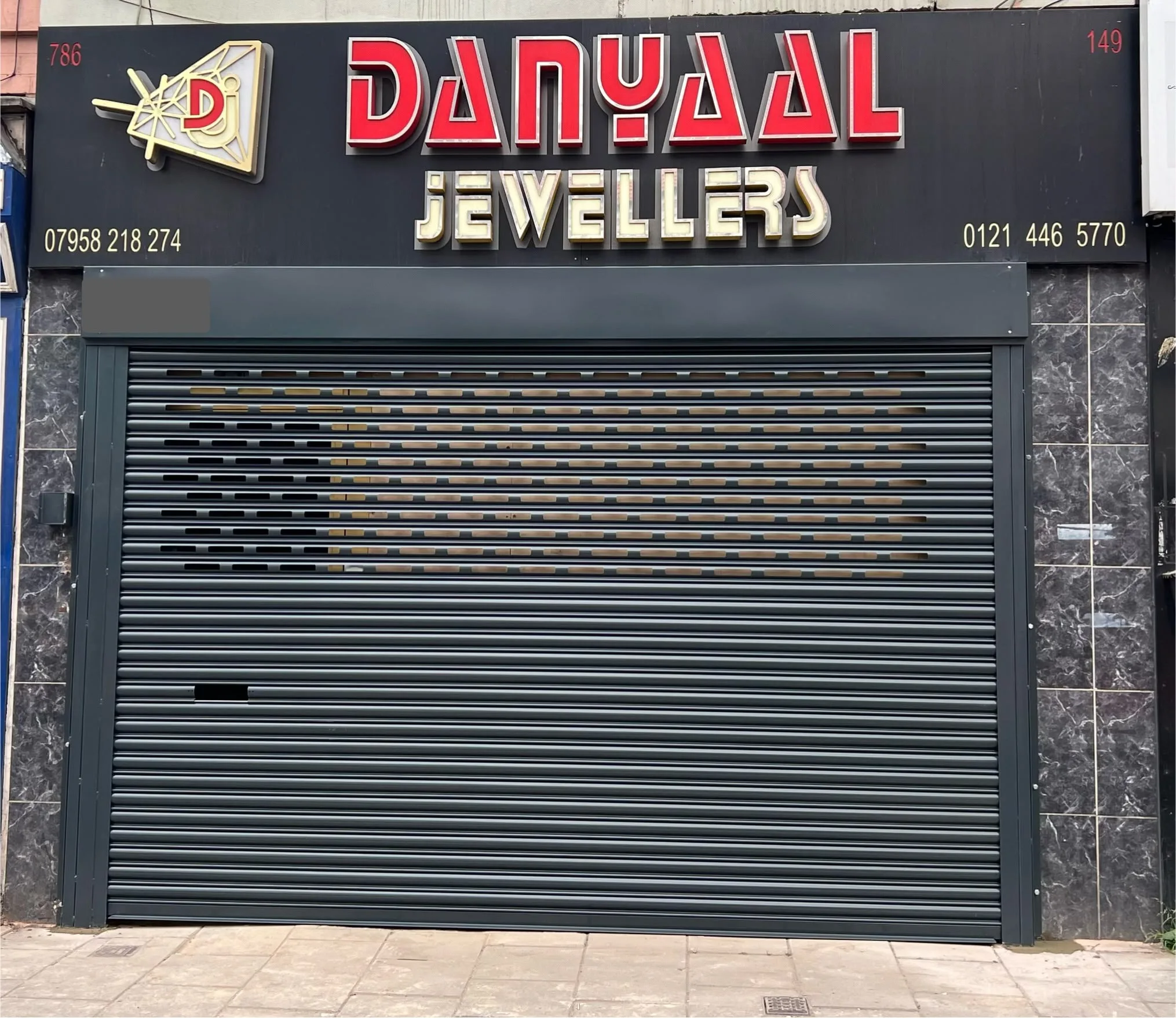
Roller Shutters
Manual and motorised roller shutters for shops, garages, warehouses and loading bays, from slim punched-lath shop shutters to heavy industrial doors.
A roller shutter is the last thing you close at night and the first thing you open in the morning, so it has to work every single time. We fit shutters on high-street shops, takeaways, petrol station kiosks, garages and industrial units, and we look after them afterwards.
Choosing the curtain
The curtain is the part that rolls up. Solid steel laths give the most privacy and resistance. Perforated laths have tiny holes, so a lit window display can still be seen at night. Punched laths have larger slots and are often fitted behind a glazed front. Insulated laths, filled with foam, suit loading bays and buildings that are heated.
If your insurer has asked for a specific security rating, tell us at the start. Rated shutters are tested as a complete set (curtain, guides, box and locking), and the certificate only counts if the whole set is fitted as tested.
Hand-operated or motorised
Small shop shutters can be pushed up by hand with spring assistance. Above about three metres wide, or where staff open up alone, a motor is the safer choice. Motors can be run from a key switch, a wall button or a remote fob, and can be set up with a safety edge that stops the curtain if it touches something on the way down.
Fire shutters
Some openings, such as those between a shop and a storage area or across a stairwell, need a fire-rated shutter that closes on its own when the alarm sounds. These are a separate product with their own testing and must be serviced so they actually drop when needed. We supply and fit them where the fire strategy calls for one.
The building matters too
A shutter is only as strong as what it is fixed to. On survey we check the brickwork or steel each side, the headroom for the box, and whether the guides can sit on the face of the wall or need to go inside the opening. Planning permission is often needed for an external shutter on a shopfront, especially a solid one, and some councils will only allow perforated or internal shutters. We will tell you before you order.
After installation
We test every shutter before we leave and show your staff how to use it and what to do if the power fails. A yearly service keeps springs, motors and safety devices in order and spots wear early.
From first call to finished job
The steps for a roller shutters job, in the order they happen.
Talk it through
We ask what you want the shutter to protect, how often it will run and whether your insurer has set any rules.
Measure and check fixings
On site we measure the opening, check the walls and headroom, and look at where power can be run for a motor.
Written specification
You receive a quote listing the lath type, colour, operation, locks and any safety devices, with one total price.
Made and fitted
Shutters are made to size, then fitted, wired and adjusted in a single visit for most shop openings.
Test and handover
We run the shutter through full cycles, check the safety devices and show staff how to open, close and override it.
Roller shutter prices
Size, operation and curtain type decide most of the cost. Here are typical figures for the shutters we fit most often.
Prices are before VAT. We confirm the exact figure in writing after the survey.
Questions people ask about roller shutters
Often you will. Many councils treat an external shutter on a shopfront as needing planning permission, and some refuse solid shutters on high streets. Internal shutters, fitted behind the glass, usually do not need it. We check your council's guidance during the survey.
Once a year for most shop shutters. Shutters that go up and down many times a day, such as on loading bays, are better checked every six months.
Most motors have a manual override, either a hand chain or a crank handle. We show you where it is and how to use it on handover day. A battery backup can also be fitted.
Usually, yes. We fit the box on the face of the fascia or behind it, depending on the space. If there is no room, a slimmer box or an internal shutter may work instead.
More answers
How long does fitting a shop shutter take?
Are motorised shutters loud?
Do insurers insist on shutters?
Can a shutter go inside the glass instead of outside?
Roller Shutters by town and city
Each page explains what we offer in that place. Repairs and call-outs are limited to the area around Coventry and Birmingham; elsewhere we take on planned installations.
- Aberdeen
- Bath
- Belfast
- Birmingham
- Bournemouth
- Bradford
- Brighton
- Bristol
- Cambridge
- Cardiff
- Chester
- Coventry
- Derby
- Edinburgh
- Exeter
- Glasgow
- Gloucester
- Leeds
- Leicester
- Liverpool
- London
- Luton
- Manchester
- Middlesbrough
- Milton Keynes
- Newcastle
- Northampton
- Norwich
- Nottingham
- Oxford
- Peterborough
- Plymouth
- Portsmouth
- Reading
- Sheffield
- Southampton
- Stoke-on-Trent
- Swansea
- Swindon
- Wolverhampton
- York
Tell us about the job
A few lines and a photo are enough to start. We reply with a ballpark price and, if it suits you, a date for a free survey.
- Free survey, no obligation
- Written price before any work
- Installs across England from Coventry